


spatial skills towards an effective STEAM Education for Sustainable Development

GEO-Academy Summer School 2025
13-18 July 2025
 The GEO-Academy summer school course is developed in the context of the project: “Innovative digital GEO – Tools for enhancing teachers’ digital, green and spatial skills towards an effective STEAM Education for Sustainable Development”.
GEO-Academy aims to create a European network offering a comprehensive teacher training and development program that will provide pre-and in-service teachers opportunities for professional learning and development by using an efficient pedagogical approach aiming at holistically educating the next generation of European citizens on Sustainable Development topics. The aim is to create a network and a community of practice to develop innovative strategies and learning modules for preparatory and continuous professional development for in-service and preservice teachers on new innovative digital technologies upon competency-based educational pedagogies.
The GEO-Academy project aims to establish a unified framework that fosters the educational, digital, environmental, and spatial skills necessary for incubator staff and to serve as a catalyst for effective Sustainable Development Education (SDE) programs both nationally and internationally.
The GEO-Academy Summer School features presentations, practical sessions, and workshops that focus on:
- Sharing knowledge and experiences to enhance participants’ understanding of site-specific challenges related to geospatial phenomena, as well as relevant methodologies and technologies.
- Promoting collaboration between teachers, students, innovators, researchers, and stakeholders in science-related fields to tackle real-world challenges and drive innovation.
- Translating scientific and research knowledge into educational practices, making it easily accessible to teachers and educators.
- Equipping teachers with cutting-edge teaching tools and expanding their expertise in phenomena-, project-, and problem-based learning through specialized teacher training and professional development programs.
- Inspiring teachers to present geospatial technologies in an engaging way for students, providing them with concrete pedagogical strategies to involve adolescents in geospatial topics.
- Offering hands-on sessions for developing educational resources and activities, as well as guidance on uploading and sharing educational scenarios, with a focus on secondary and high school curricula
Find out more about the GEO-Academy here: https://geoacademy.eu/
The main objectives of the course are:
- Integrating digital skills related to current and emerging geotechnologies into educational practices to enhance both participation and success in STEAM disciplines, as recognized through various studies and models.
- Leveraging the digital opportunities of the ongoing transformation by creating and utilizing innovative GIS, Remote Sensing (RS), and Earth Observation (EO) tools, applications, and modeling schemes.
- Employing Digital Storytelling and supporting materials as pedagogical tools to foster an interdisciplinary teaching and learning environment, empowering teachers across Europe to be skilled, open-minded, and prepared to address Sustainable Development topics and Education for Sustainable Development (ESD).
- Elevating the role of schools as social innovators and active contributors to efforts addressing climate change, positioning schools, teachers, and students as “green and geo innovators,” ambassadors, and environmentally conscious citizens.
- Promoting sustainable professional learning and development for both pre-service and in-service teachers by offering flexible training opportunities that incorporate cutting-edge professional development approaches, supported by teaching materials and guidelines for student instruction.#
The GEO-Academy Winter School is designed to be highly engaging, creative, and interactive. Participating teachers will work as individuals and in small groups. Thus, they will be able to collaborate with teachers from other countries, discuss ideas, and exchange experiences to create lesson plans and group activities which will encompass all the features of successful interdisciplinary science activities.
The course will last for 5 days, consisting of a total of 29 hours of workshop-based training, such as presentations followed by hands-on sessions (12 hours of lectures and demonstrations, 17 hours of hands-on workshops). The lectures and the demonstrations of the training courses will be held in an auditorium equipped with a data projector and a laptop,we kindly ask each participant to bring their laptops, will have direct access to a laptop with an internet connection and will carry out planned exercises.
One important aspect of the training activities is the collected feedback and the common discussion among participants. We will provide a platform to exchange ideas and talk in detail about the requirements concerning various aspects of the tools shown to facilitate their further development, maximize their efficiency, and enhance their adaptation potential.
To ensure the proper preparation for the training course an online platform will act as a main hub of communication and for sharing and distributing preparatory material with the participants. Through this platform the participants will have access to all materials necessary for their preparation (suggested reading, digital tools, relevant websites, guidelines, and support material etc.) and a common workspace. Moreover, all the information regarding the training course such as the course description, the program, travelling and accommodation guidelines will also be accessible through the website.
Participants will familiarize themselves with the training topics as well as the course methodology by accessing the relevant resources, materials and tools. Based on their interests they will be invited to participate into one of the working groups each of which will have a different main topic of focus.
At the end of the course, following the presentation of their work on the last day of the course, participants will receive a training certificate that confirms the successful completion of the course and its objectives.
As members of the GEO-Academy community participants will have access to support provided by the training team, and they will be able to communicate with other teachers in European countries, who have a common interest, share their ideas, and experience, and collaborate in joint activities.
Through the training sessions they will organize they will be able to further disseminate their work and inspire more teachers to use their activities and the GEO-Academy tools and services.
To assess whether, and to what extent, the course has reached its objectives and expected results the participants will have to answer, during and at the end of the course, a set of relevant questionnaires that will be provided by the course providers. The results of the questionnaires/survey or a so-called evaluation report will be available to all participants of the course.

Course fee
The course fee for all ESIA Summer Schools is 480€ (80€/per day) and fully within the funding opportunities of the Erasmus+ Programme.
The course fee covers:
- Expert lecturers for lectures, seminars and workshops
- All materials and equipment needed for the course
- Participation in the social programme & excursions (e.g. visiting Schönbrunn Palace , farewell dinner)
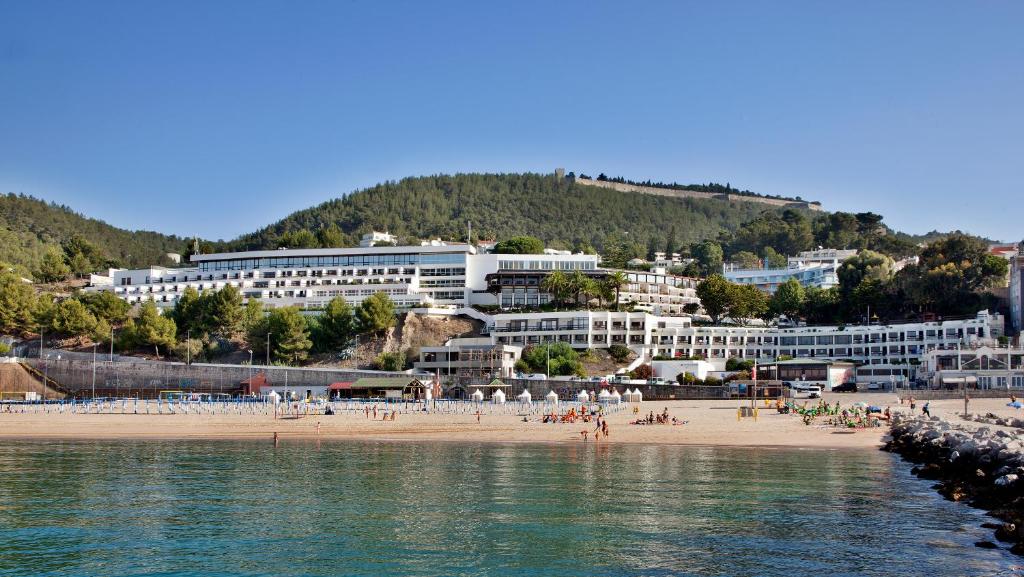
The Summer School will be held at Hotel do Mar Sesimbra, A 4-star hotel built on a hillside overlooking the beach of Sesimbra.
The costs for subsistence are also within the ceilings of the Erasmus+ programme for KA1 mobility actions.
School Heads and Teachers participation in the summer courses can be funded by the ERASMUS+ Programme.
In case your school or organization does not have the funds to cover the costs of your participation in the Summer School, there is another option: you can apply to be funded by by the ERASMUS+ Programme.
Please note that the Erasmus+ KA1 application can only be submitted by the school or the organization – no individual applications can be submitted.
The deadline for application is 19 February 2025.
What is ERASMUS+?
Erasmus+ is the European Commission’s Programme for education, training, youth, and sport for the period 2021-2027. As an integrated programme, Erasmus+ offers more opportunities for the mobility of learners and staff and cooperation across the education, training, and youth sectors and is easier to access than its predecessors, with simplified funding rules and a structure that aims to streamline the administration of the programme.
Erasmus+ Key Action 1 (KA1) provides a unique opportunity for teachers, headmasters, trainers, and other staff of educational institutions to participate in international training courses in different European countries. Schools, universities, vocational education and training, and adult education organizations are all eligible to receive full funding to attend courses under a KA1 mobility grant. The Erasmus+ KA1 grant covers all the costs to attend teacher training courses: including travel, subsistence, and course fee.
For up-to-date information about Erasmus+ please check the Programme’s website. Your school will need to apply to your country’s National Agency, who is also the one who will evaluate the proposal. Therefore, your National Agency is also a very good point to start for more information.
Don’t forget to go through the the New Programme Guide and you will have all you need to know.
The steps to apply for an Erasmus+ KA1 School Education Staff Mobility grant are:
- Fill in the registration form to our Summer School with your details. This is an individual registration form, so if there are more than one participant from the same school, each one will have to submit a separate registration form. This way you have reserved a slot in the course in case your application for Erasmus+ funding is successful!
- Register your school/organization here: https://webgate.ec.europa.eu/erasmus-esc/index/ , if not already registered.
- Check the compliance with the programme criteria
- Check the financial conditions
- Fill in and submit the application form
- Respect the deadline
- Do not forget to inform us as soon as you get notified from your National Agency whether your grant application is accepted or rejected.
You can find all related information about submitting an Erasmus+ Application HERE.
We will be happy to guide you through the process.