


BRIDGES International Course 2026
28 June - 3 July 2026
 The Green Deal sets out the European Union’s goal towards just economic and ecological transitions. Moving to a climate-neutral EU will have significant social, economic, and employment impacts. A socially just transformation needs people to have the knowledge, skills, and attitudes to shape and cope with profound change. Education and training can act as catalysts and support a shift to a more sustainable society. The school communities, as building blocks of societies, can actively contribute to this shift if teachers and students have the relevant competences required.
To accomplish this, they need to understand and value the world we live in, the natural environment, and our responsibility for maintaining it by instilling an environmental awareness that leads to a shared sense of Sustainability Citizenship. Thus, we need to connect the learning of basic skills and competences with a deeper sense of responsible citizenship, coupled with and based upon scientific knowledge and an understanding that, altogether, provides meaning to information.
In this way, young people will learn to value data-based information, solve problems, make educated decisions, and take advantage of opportunities. Without the ability to critically evaluate information, scientific concepts can be misunderstood, and pseudo-scientific reasoning can mislead people. Therefore, young people need to develop the necessary dispositions and become informed citizens capable of using their competences in science and technology wisely to solve the numerous global problems societies now face.
Sustainability Citizenship is a concept that integrates principles of sustainability into the roles, responsibilities, and rights of citizens. It is a form of citizenship that acknowledges the importance of balancing economic, social, and environmental aspects to ensure a sustainable future for all. Sustainability Citizenship views citizenship as a total practice of responsibility between individuals and their political, social, economic, and natural environment.
Climate change-relevant Sustainability Citizenship competences include the ability to recognise the environmental, social, and economic dimensions of climate change, to understand the causes and consequences of climate change, evaluate information as well as strategies to mitigate and adapt to its impacts, the ability to connect local actions and initiatives to global processes, and the capacity to move from analysis to systematic action on climate change, imagine and design solutions, individually and collectively.
The BRIDGES International Development Course, part of the Erasmus+ project BRIDGES on Sustainability Citizenship, supports the school communities to foster the competences for the green transition by providing the appropriate methodology and resources, encouraging integration across stakeholder groups and disciplines, identifying and disseminating best practices, and fostering collaboration with the scientific community and other entities committed to education for sustainable development. The participants will:
- Develop and implement sustainability-focused curricula that address environmental topics, climate change, and responsible citizenship across multiple subjects.
- Design and assess learning interventions that integrate the key features of Sustainability Citizenship in the school environment.
- Explore inquiry-based, project-based, and challenge-based instructional methods using innovative tools.
- Enhance collaboration and networking skills by engaging in communities of practice and strengthen cross-cultural competence by working with peers from diverse backgrounds and regions, broadening perspectives on global environmental challenges.
- Integrate interdisciplinary approaches by collaborating with various stakeholders (scientific communities, environmental organizations, and other schools) to create holistic educational experiences that address complex sustainability issues.
The BRIDGES International Development Course aims to answer questions such as: How can we create an effective learning continuum towards sustainability? How can we facilitate stronger links and connections between the different learning settings and actors, who are often in the position to enhance a “deeper learning” on environmental and sustainability issues? How can we design and implement interventions that will transform our school into a living lab of sustainability and an “accelerator” of pro-environmental behavior? How will we measure the impact of our actions?
Over the training days, various topics will be explored, such as the key features of Sustainability Citizenship, the Whole School Approach as a pathway to integrate sustainability into the school environment, the concept of open schooling, and various initiatives, good practices, examples, and activities to reimagine school infrastructure, curricula, teaching, and learning.
The main objectives of the BRIDGES International Development Course are to:
- Provide teachers and heads with the knowledge, tools, and strategies needed to effectively integrate and sustain sustainability citizenship in their schools.
- Present inquiry-based, project-based, and challenge-based learning approaches, supported by digital tools and resources.
- Build a vibrant community of practice among European educators, enabling the exchange of best practices and the co-creation of innovative educational materials.
- Support whole-school approaches to sustainability, facilitating collaboration between formal and informal learning environments.
- Provide a standards-based framework and assessment mechanisms that integrate sustainability competences into national curricula.
The BRIDGES Course is designed for school heads and teachers of both primary and secondary schools. The proposed approach concerns the whole school community and addresses objectives and responsibilities at all levels.
At the BRIDGES Summer School, teacher participants will develop an educational scenario for implementing in their schools that promotes sustainability citizenship, while school head participants will create a green action plan for implementing in their schools that promotes sustainability citizenship. The summer school will use the BRIDGES portal to demonstrate best practices and upload preparatory work. The portal will serve as a repository for summer school materials and facilitate networking among participants.
Reference Documentation
- Schools as Nature-Based Solutions (NBS) Living Labs: A Roadmap for Transformation
- GreenComp Framework
- Designing Environments for Teaching Sustainability Citizenship in Schools
- Schools as Nature-Based Solutions Living Labs: Inspiring Stories of Implementation
- Schools as enablers of the New European Bauhaus
- FoodShift Pathways
- Ask Nature
- Nature-Based Solutions
- Biomimicry in Schools
- Portfolio of ‘Schools as Living Labs’ Projects

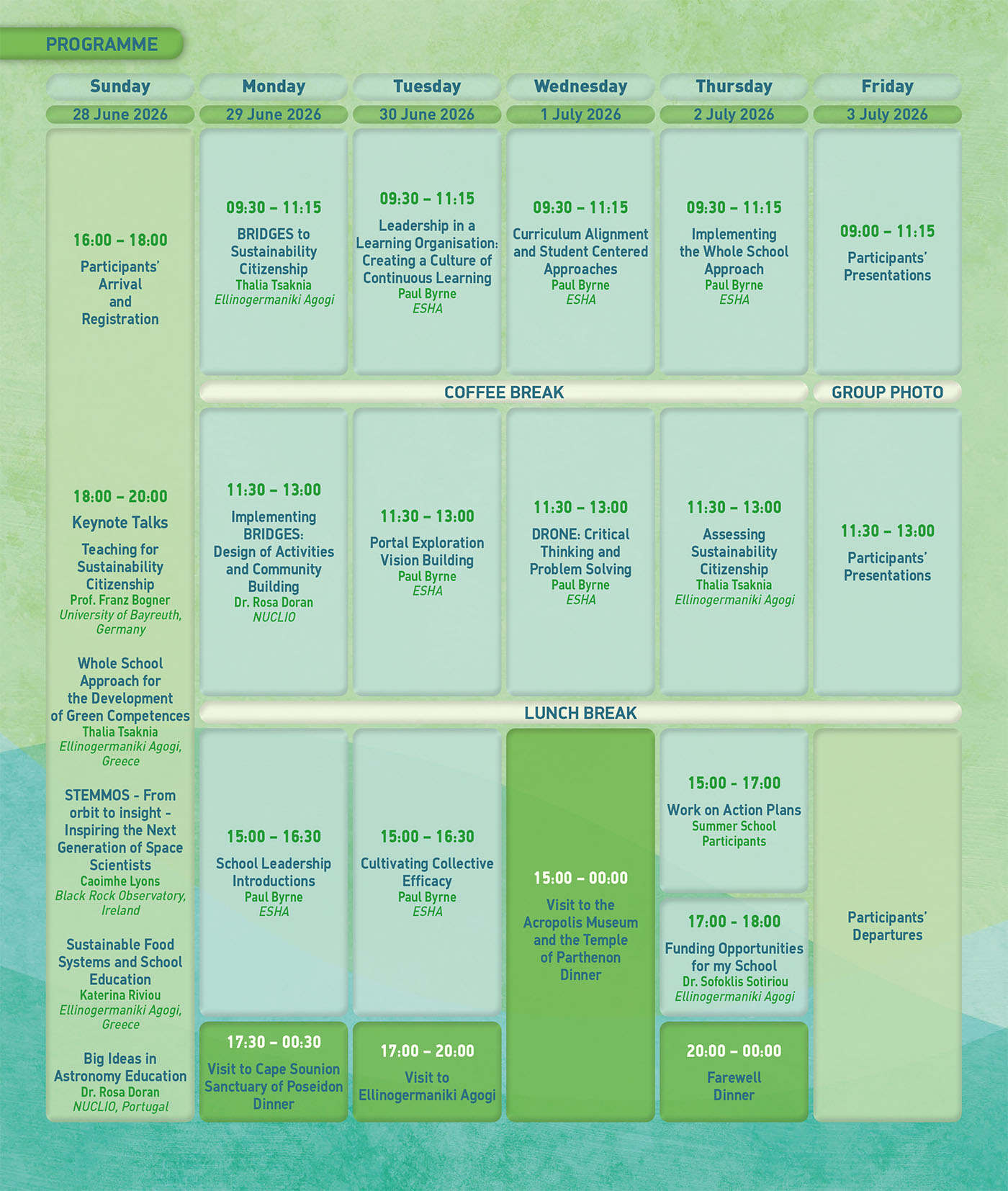
Upon completing the course, participants will present their projects and receive constructive feedback from both trainers and peers. These projects will form the basis for implementation in their schools/classrooms. Participants will be encouraged to pilot the materials and methods they have developed, tailoring them to their local contexts. Through the BRIDGES Portal, the online platform that connects educators worldwide, participants will share experiences, exchange resources, and collaborate within both country-specific and international community. Trainers will provide ongoing support via the portal and during international reflection workshops, ensuring sustained professional growth and engagement.
In addition, BRIDGES will regularly organize meetings and webinars, while the portal will be continually enhanced with practical resources (such as best practices) to support seamless application in the classroom.
Course fee
The course fee for all ESIA Summer Schools is 480€ (80€/per day) and fully within the funding opportunities of the Erasmus+ Programme.
The course fee covers:
- Expert lecturers for lectures, seminars and workshops
- All materials and equipment needed for the course
- Participation in the social programme & excursions (e.g. Sunset and dinner at Cape Sounio, excursion to the Acropolis and visit to the Acropolis Museum and dinner in downtown Athens, traditional night and farewell dinner, etc.)
Subsistence & accommodation
The Summer School will be held at Golden Coast Hotel & Bungalows, an A-class/ 4-star sea-side hotel which stretches on the golden, sandy beach of the Marathon Bay, near the historic location of Marathon, at the outskirts of Athens.
ESIA has made special arrangement with the hotel and are happy to offer to all participants a single or double room with all-inclusive services (i.e. breakfast, lunch, dinner, drinks and free of charge services for outdoors sports and recreational activities).
The costs for subsistence are also within the ceilings of the Erasmus+ programme for KA1 mobility actions.
ACCOMMODATION AT GOLDEN COAST HOTEL 2026 (Indicative prices)
COST FOR THE PARTICIPANTS (All Inclusive)
- Per person in SINGLE: 140 €/per night
- Per person in DOUBLE: 98 €/per night
Extra persons (All Inclusive)
- TRIPLE room: 88 €/per person/per night
EXTRA SERVICES (the following refers to other project participants that don’t pay the course fee)
TOURS & EXCURSIONS
Cape Sounio Tour (Price: 100 €/per person)
Monday @ 18:00
Includes:
-
- Transport by bus (Golden Coast – Cape Sounio – Golden Coast)
- Guided tour of Poseidon temple with Professional and Lisensed guide
- Entrance fees of the Temple of Poseidon
- Lunch at local tavern
- All taxes
Athens tour & Acropolis Museum (Price: 123 €/per person)
Wednesday @ 16:00
Includes:
-
- Transport by bus (Golden Coast – Athens – Golden Coast)
- Short panoramic tour by bus of historic center of Athens
- Services of a Professional and licensed guide
- Entrance fees of Acropolis museum
- Lunch at local tavern
- All taxes
+ Entrance fees to the Acropolis Archaeological Site ticket cost of 30 €/per person.
+ Entrance fees to the Sounio Archaeological Site ticket cost of 20 €/per person.
*** The above prices are calculated based on current costs, tickets to museums / archeological sites, fuel cost, VAT
 The Summer School will be held at Golden Coast Hotel & Bungalows, an A-class/ 4-star sea-side hotel which stretches on the golden, sandy beach of the Marathon Bay, near the historic location of Marathon, at the outskirts of Athens.
It is the area of Marathon, that has hosted since the times of myths when Theseus killed the terrible bull of Marathon, to the times of the Persian wars and the Battle of Marathon, further on to our days and the marathon race and Marathon Run, the emblematic symbol of man’s quest for freedom and the will to defend his most noble deeds which constitute the foundations of the Human civilization. The plethora of natural, historical sites and museums of the area reveal in all details this unique historical voyage.
Participants are expected to arrive through the Athens International Airport, approximately 25 km (15,53 miles) distance from the hotel.
School Heads and Teachers participation in the summer courses can be funded by the ERASMUS+ Programme.
In case your school or organization does not have the funds to cover the costs of your participation in the Summer School, there is another option: you can apply to be funded by by the ERASMUS+ Programme.
Please note that the Erasmus+ KA1 application can only be submitted by the school or the organization – no individual applications can be submitted.
The deadline for application is February 19, 2026.
What is ERASMUS+?
Erasmus+ is the European Commission’s Programme for education, training, youth, and sport for the period 2021-2027. As an integrated programme, Erasmus+ offers more opportunities for the mobility of learners and staff and cooperation across the education, training, and youth sectors and is easier to access than its predecessors, with simplified funding rules and a structure that aims to streamline the administration of the programme.
Erasmus+ Key Action 1 (KA1) provides a unique opportunity for teachers, headmasters, trainers, and other staff of educational institutions to participate in international training courses in different European countries. Schools, universities, vocational education and training, and adult education organizations are all eligible to receive full funding to attend courses under a KA1 mobility grant. The Erasmus+ KA1 grant covers all the costs to attend teacher training courses: including travel, subsistence, and course fee.
For up-to-date information about Erasmus+ please check the Programme’s website. Your school will need to apply to your country’s National Agency, who is also the one who will evaluate the proposal. Therefore, your National Agency is also a very good point to start for more information.
Don’t forget to go through the the New Programme Guide and you will have all you need to know.
The steps to apply for an Erasmus+ KA1 School Education Staff Mobility grant are:
- Fill in the registration form to our Summer School with your details. This is an individual registration form, so if there are more than one participant from the same school, each one will have to submit a separate registration form. This way you have reserved a slot in the course in case your application for Erasmus+ funding is successful!
- Register your school/organization here: https://webgate.ec.europa.eu/erasmus-esc/index/ , if not already registered.
- Check the compliance with the programme criteria
- Check the financial conditions
- Fill in and submit the application form
- Respect the deadline
- Do not forget to inform us as soon as you get notified from your National Agency whether your grant application is accepted or rejected.
You can find all related information about submitting an Erasmus+ Application HERE.
We will be happy to guide you through the process.
The hosting organisation of the summer school is Ellinogermaniki Agogi, OID: E10212356